High-Quality Tubesheet Steel Forging for Heat Exchangers - China Suppliers and Factory Solutions
In the design calculations for fixed tube sheet heat exchangers, it is crucial to ensure that the axial stress of the shell, the axial stress of the heat exchange tube, and the pulling force between the heat exchange tube and the tube sheet meet the required strength and stability standards. If these criteria are not satisfied, installing an expansion joint becomes essential to maintain optimal performance. As a leading factory in China, we specialize in providing high-quality heat exchange solutions and reliable expansion joints, ensuring that our products meet the stringent demands of various industries. Trust our suppliers for innovative designs and superior engineering that enhance the efficiency and longevity of your heat exchanger systems
In the design calculations for fixed tube sheet heat exchangers, if there is a situation where the axial stress of the shell, the axial stress of the heat exchange tube, or the pulling force between the heat exchange tube and the tube sheet cannot meet the strength (or stability) requirements, it becomes necessary to install an expansion joint. In some cases, after determining the thickness of the tube sheet, the strength of the tube sheet may not be sufficient without an expansion joint. However, by adding an expansion joint, the tube sheet thickness may then meet the requirements. In such cases, the decision to install an expansion joint should be based on a comprehensive evaluation of material consumption, manufacturing difficulty, safety, and economic effects.
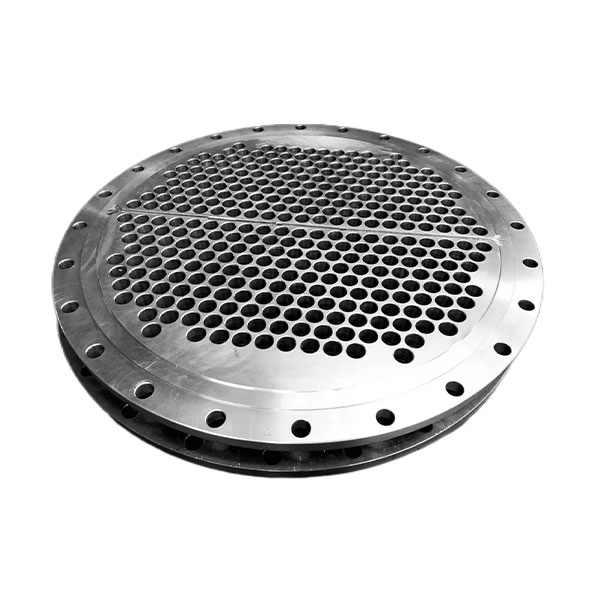
The commonly used type of expansion joint in fixed tube sheet heat exchangers is the U-shaped expansion joint, which is compact, simple in structure, has good compensation properties, and is cost-effective. With the increasing size of chemical equipment and power plants, the diameters of tube sheets have become larger, with diameters of 4m to 5m being common. Large tube sheets are characterized by a large number of densely packed small, deep holes with high precision and cleanness requirements.
Industrial Applications of Tube Sheets
Tube sheets are widely used in industries such as shell and tube heat exchangers, boilers, pressure vessels, turbines, and large central air conditioning systems. They are mainly used to support and fix the tubes in chemical containers, such as shell and tube heat exchangers, pressure vessels, boilers, condensers, central air conditioning systems, evaporators, and seawater desalination plants. The metal material of tube sheets provides not only high rigidity but also excellent heat conduction properties.
Fabrication, Welding & Corrosion Challenges
During the fabrication of shell and tube heat exchangers, the welding of the tube sheet and tubes is generally done using manual shielded metal arc welding, leading to the presence of defects in the weld shape, such as depressions, pores, and inclusions, as well as non-uniform distribution of weld stresses. When in use, the tube sheet parts typically come in contact with industrial cooling water, which may cause corrosion of the tube sheet and the welds due to impurities, salts, gases, and microorganisms present in the industrial cooling water—this is known as electrochemical corrosion.
Research indicates that industrial water, whether fresh or seawater, contains various ions and dissolved oxygen, with the concentration variations of chlorine ions and oxygen playing an important role in the corrosion shape of metals. Additionally, the complexity of the metal structure can also influence the corrosion morphology. Therefore, the primary corrosion types of tube sheet and tube welds are pitting corrosion and crevice corrosion.
Frequently Asked Questions
Q
When is it necessary to install an expansion joint in a fixed tube sheet heat exchanger?
An expansion joint is required when the axial stress of the shell, the axial stress of the heat exchange tube, or the pulling force between the tube and the tube sheet cannot meet strength or stability requirements. It may also be added to help the tube sheet thickness meet safety requirements.
Q
What type of expansion joint is most commonly used and why?
The U-shaped expansion joint is the most commonly used type because it is compact, simple in structure, cost-effective, and offers excellent compensation properties.
Q
What are the primary industrial applications of tube sheets?
Tube sheets are widely used to support and fix tubes in shell and tube heat exchangers, boilers, pressure vessels, steam turbines, large central air conditioning systems, evaporators, and seawater desalination plants.
Q
What causes electrochemical corrosion in tube sheets?
Electrochemical corrosion occurs when tube sheets and welds come into contact with industrial cooling water containing impurities, salts, gases, and microorganisms, which react with weld defects and non-uniform stresses.
Q
What are the main types of corrosion found on tube sheets and tube welds?
The primary corrosion types are pitting corrosion and crevice corrosion, which are heavily influenced by the concentration of chlorine ions, dissolved oxygen in the water, and the complexity of the metal structure.