


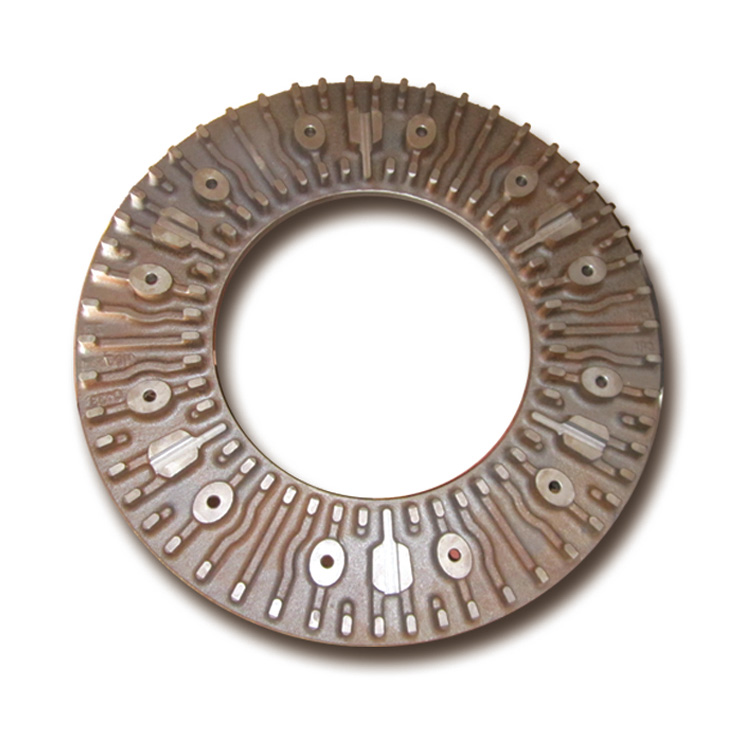
High-Quality Brake Discs for Trains and Freight Cars - Trusted China Suppliers & Factory提供
Brake discs (also known as brake rotors or brake discs) are important components used for braking in automobiles and other vehicles. They are generally made of metal materials, usually cast iron or steel. The fundamental principle of brake discs is to slow down or stop the vehicle's motion by friction with the brake pads. Here is a detailed introduction to brake discs, including their structure, working principle, types, and related technological developments.
Structure
Brake discs are typically circular metal components installed around the vehicle's wheels. They are made of a smooth, flat, circular metal disc designed to provide friction with the brake pads. The brake discs are fixed to the wheels, and when the brake pedal is pressed, the brake pads clamp onto the brake disc, thereby slowing down the vehicle's motion. Brake discs usually have cooling channels and cooling fins to aid in heat dissipation, preventing overheating and fading to provide more durable and stable braking performance.
Working Principle
When the driver presses the brake pedal, the braking system transmits pressure to the brake pads, causing them to clamp onto the surface of the brake disc. As a result of friction, the brake disc encounters resistance, thereby slowing down the vehicle's speed. This process converts kinetic energy into heat, so brake discs need to have good heat dissipation capabilities to prevent overheating. When the force of friction ceases to act, the vehicle comes to a stop.
Types
Brake discs come in several different types to meet various requirements and vehicle types. The main differences typically lie in the material and manufacturing process of the brake discs. High-performance vehicles may utilize carbon ceramic brake discs, known for their superior heat dissipation and wear resistance, making them suitable for high-temperature and high-speed operations. Additionally, ventilated brake discs are a common type with surfaces containing cooling channels, offering faster heat dissipation and are suitable for vehicles requiring substantial braking force.
Technological Developments
With the continuous development of the automotive industry, brake disc technology is constantly being innovated and improved. Some manufacturers are researching lightweight and more wear-resistant brake disc materials to enhance braking performance and reduce wear rates. Furthermore, new designs of brake discs have emerged, such as intelligent brake discs equipped with electronic sensors that can monitor braking temperature and wear conditions in real-time, thereby enhancing vehicle safety and stability.
In Conclusion
As a crucial component of the vehicle braking system, brake discs play a vital role in the braking performance and safety of the vehicle. With advancing technology, the materials, design, and manufacturing processes of brake discs are continuously being innovated and improved to meet the requirements of different vehicle types and driving environments, providing more reliable and safer braking performance.
Frequently Asked Questions (FAQ)
Q: What materials are brake discs commonly made of?
Brake discs are generally made of metal materials, usually cast iron or steel. High-performance vehicles may also utilize carbon ceramic materials for better performance.
Q: How do brake discs slow down or stop a vehicle?
Brake discs work by friction. When the brake pedal is pressed, the brake pads clamp onto the surface of the rotating brake disc, creating resistance that converts kinetic energy into heat and slows the vehicle down.
Q: Why is heat dissipation important for brake discs?
The braking process converts kinetic energy into significant heat. Proper heat dissipation, aided by cooling channels and fins, prevents overheating and brake fade, ensuring stable and durable braking performance.
Q: What are the advantages of carbon ceramic brake discs?
Carbon ceramic brake discs offer superior heat dissipation and wear resistance compared to standard metal discs. This makes them ideal for high-temperature and high-speed operations in high-performance vehicles.
Q: What are the latest innovations in brake disc technology?
Recent technological developments include the research of lightweight and wear-resistant materials, as well as the creation of intelligent brake discs equipped with electronic sensors to monitor temperature and wear in real-time.